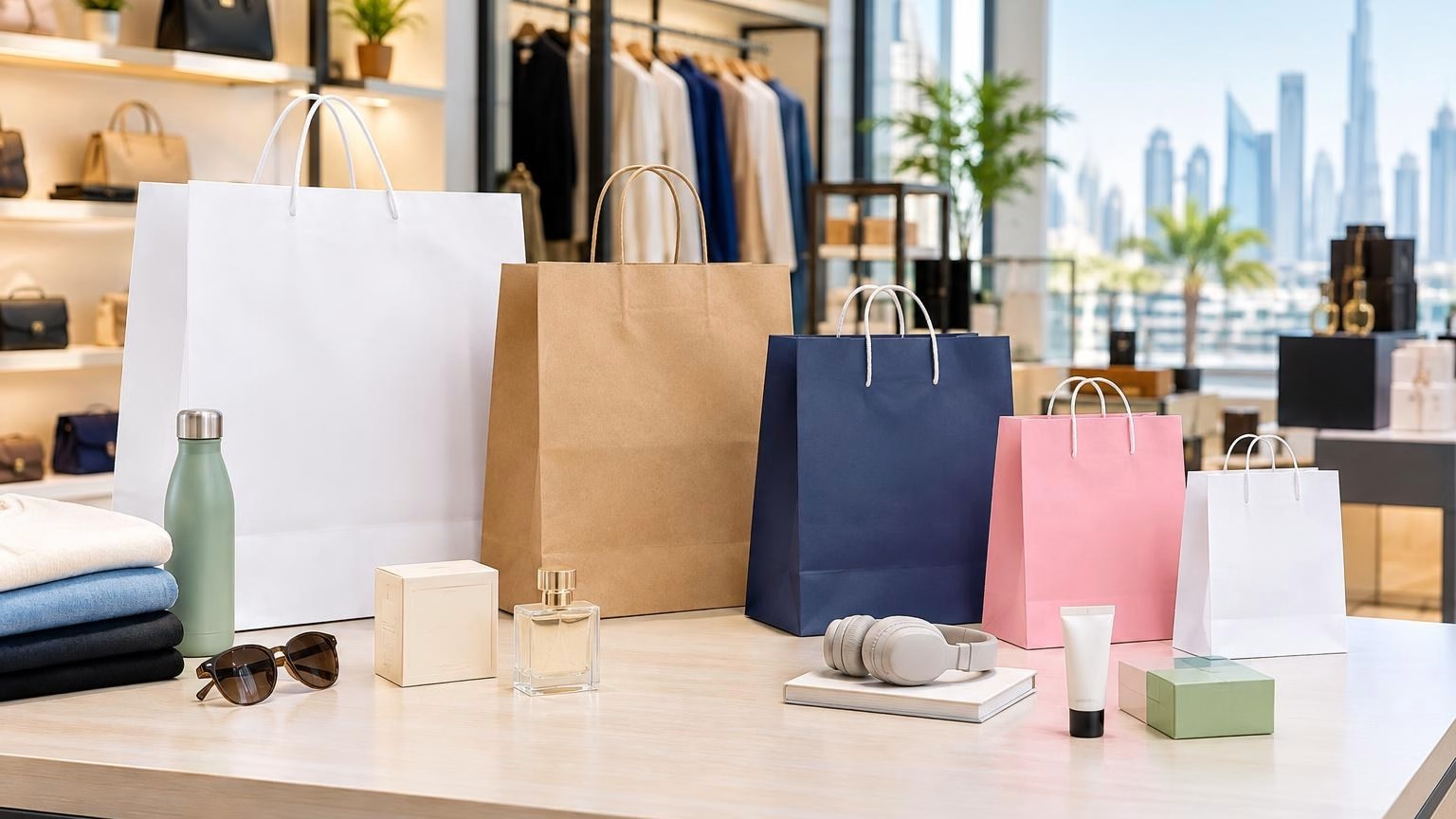
Choose shopper bag sizes by measuring the products customers actually buy, then allowing enough room for their packaging, shape and easy handling. For UAE retailers, the right fit depends on the product range, how customers will carry the bag and how much visible space your branding needs.
Start with the largest or most awkward items in each product group. Compare their dimensions with the bag’s usable inside space, including its depth or gusset, and test common product combinations before settling on a size. A bag should feel practical when filled, not simply look suitable when empty.
Quick answer: Measure products at their widest, tallest and deepest points; allow practical clearance; check the bag’s internal width, height and gusset; then test typical purchases together. Confirm handle comfort, intended contents, print area and final dimensions before approving an order.
Why shopper bag size matters for UAE retail
A shopper bag is part of the handover between retailer and customer. If it is too small, products can be difficult to pack or may not fit safely. If it is much larger than the purchase, items can shift around and the bag may feel awkward to carry. A considered size helps balance product protection, customer convenience and brand presentation.
Retail conditions vary across Dubai and the wider UAE. A bag used for a quick in-store purchase may have different needs from one carrying a boxed gift, several purchases or products taken outdoors. Think about the whole journey from the counter to the customer’s destination—not just the appearance of an empty bag.
Understand the dimensions before choosing
Shopper bag dimensions are commonly discussed as width, height and gusset or depth. The precise order and measurement method can vary, so confirm how a supplier labels each dimension and whether it refers to the finished bag’s outside or usable inside space.
- Width: The space across the front of the bag. It needs to accommodate the product’s widest side.
- Height: The vertical space available for the product. Check how far the item will sit below the opening.
- Gusset or depth: The side or bottom expansion that accommodates thicker and boxed items.
Do not rely on width and height alone for a deep product. A flat bag may fit an item across its front but still be too shallow to close or carry comfortably. Ask for a dimension diagram if the measurement terms are unclear.
Measure products and typical purchase combinations
Measure the actual item in its retail-ready condition. If it comes in a box, sleeve or protective wrap, measure the packed product rather than the unpackaged item. Include projecting parts, rigid corners, handles or other features that affect how it fits.
- Measure the item at its widest point, tallest point and greatest depth.
- Repeat for the product with its normal packaging.
- List the combinations customers commonly buy together.
- Check whether those items can sit side by side, stack safely or need to remain upright.
- Allow practical clearance for packing and removal instead of specifying a tight fit.
For example, a retailer selling a small accessory and a boxed item should check whether one bag can accommodate both without forcing them together. A clothing shop may need to consider folded garments, while a gift retailer may need space for a presentation box. These are different packing situations, even when the products appear similar in size.
Match the size to the shopping purpose
Choose a size around what the bag is expected to carry most often. Consider the customer, purchase type and way the bag will be used after checkout.
| Retail use |
What to assess |
Sizing priority |
| Small, lightweight purchases |
Whether the bag stays neat and easy to hold when lightly filled |
A proportionate fit rather than excess unused space |
| Boxed retail products |
Box width, height, depth and corner protection |
Enough gusset and clearance for easy packing |
| Several items in one purchase |
Typical combinations, stacking and movement inside the bag |
Capacity for the combined order, not just one item |
| Bulky or irregular products |
Protrusions, orientation and the widest point |
A shape that accommodates the product without forcing it |
| Gift or premium purchases |
Presentation, packaging and the customer’s carrying experience |
A balanced fit that supports a considered handover |
This comparison is a planning guide, not a list of standard bag sizes. The dimensions that work depend on the product and the bag format being considered.
Consider material, format and carrying conditions
Size is only one part of the decision. The material, construction and handle format should suit the contents and expected use. A lightweight purchase, a heavy boxed product and a fragile item can place different demands on a bag. Do not assume that a larger bag is automatically suitable for heavier contents.
Before choosing a format, discuss the intended products and carrying conditions with the supplier. Ask what material and handle options are available, how the bag is intended to be used and what load guidance applies. Consider whether customers may carry it outdoors, reuse it or place it alongside other purchases. Confirm suitability rather than relying on appearance alone.
Plan branding around the finished bag
A branded shopper bag can keep a business visible as the customer carries it, but artwork needs to work with the bag’s shape and usable print area. Allow for folds, seams, handles and the way the bag may flex when filled. A logo that looks centred on a flat design may appear differently once the bag is assembled or carried.
- Use artwork prepared to the supplier’s dimensions and file requirements.
- Check logo size, placement, colour and legibility at the intended viewing distance.
- Keep important design details clear of folds, edges and handle areas.
- Review a proof and, if available, a physical sample before confirming production.
If you need help preparing artwork, see IWPrinting’s Graphic Design Services. For other retail branding formats, the guide to printing stickers for packaging and products can help you consider how branded elements work together.
Plan sizes and quantities around your product range
Before requesting a quote, make a simple list of the products and purchase combinations the bags need to accommodate. This helps you decide whether one versatile size is practical or whether separate sizes would reduce empty space and improve the fit.
Consider sales patterns and storage as well as the checkout experience. A size used for most orders may be the priority, while a less common size may be needed for particular products or gift purchases. Share your planned size mix and intended use when asking about an order. Confirm quantities, available options and any order requirements directly with the supplier; these details can vary and should not be assumed.
If the bag is part of a wider delivery or packaging plan, compare its role with the packaging needed to protect goods in transit. IWPrinting’s guide to choosing custom e-commerce mailer boxes in the UAE covers a different format designed around the delivery journey.
A practical checklist before confirming a bag size
- Have you measured the product in its final retail packaging?
- Have you included width, height and depth, as well as any protruding parts?
- Have you tested the combinations customers commonly purchase?
- Do you understand the supplier’s measurement method and usable internal space?
- Are the handle, material and construction suitable for the intended contents and use?
- Does the artwork fit the available print area and avoid folds or handles?
- Have you checked the final dimensions and proof or sample where available?
- Have you confirmed the planned size mix, quantities and order details with the supplier?
Frequently asked questions
How do I measure a product for a shopper bag?
Measure the product’s maximum width, height and depth, including protruding parts or packaging. Compare those measurements with the usable space inside the bag, not only its outside dimensions. Leave room to pack and remove the product without forcing or damaging it.
What does gusset mean in shopper bag dimensions?
A gusset is the added depth or side panel that lets a bag expand around a product. It matters for thick, boxed or irregularly shaped items. Check how the supplier describes the bag’s dimensions and confirm which measurement refers to the gusset.
Should all products in a shop use the same bag size?
Not necessarily. One size can be convenient for a narrow product range, but it may be oversized for small purchases or unsuitable for bulky items. Group products by common purchase combinations and consider whether two or more sizes would serve customers better.
What should I check before ordering branded shopper bags?
Confirm the finished dimensions, usable internal space, handle placement, intended contents and print area. Prepare artwork to the supplier’s requirements and review a proof or sample where available. Confirm the quantity, size mix and order requirements directly with the supplier.
Choose a size that works in real use
The most useful shopper bag size is the one that fits the products customers actually buy, is comfortable to carry and gives your branding a clear, considered place. Measure, test typical purchases and confirm the final specifications before proceeding. Contact IWPrinting to discuss your shopper bag requirements and the options available for your project.