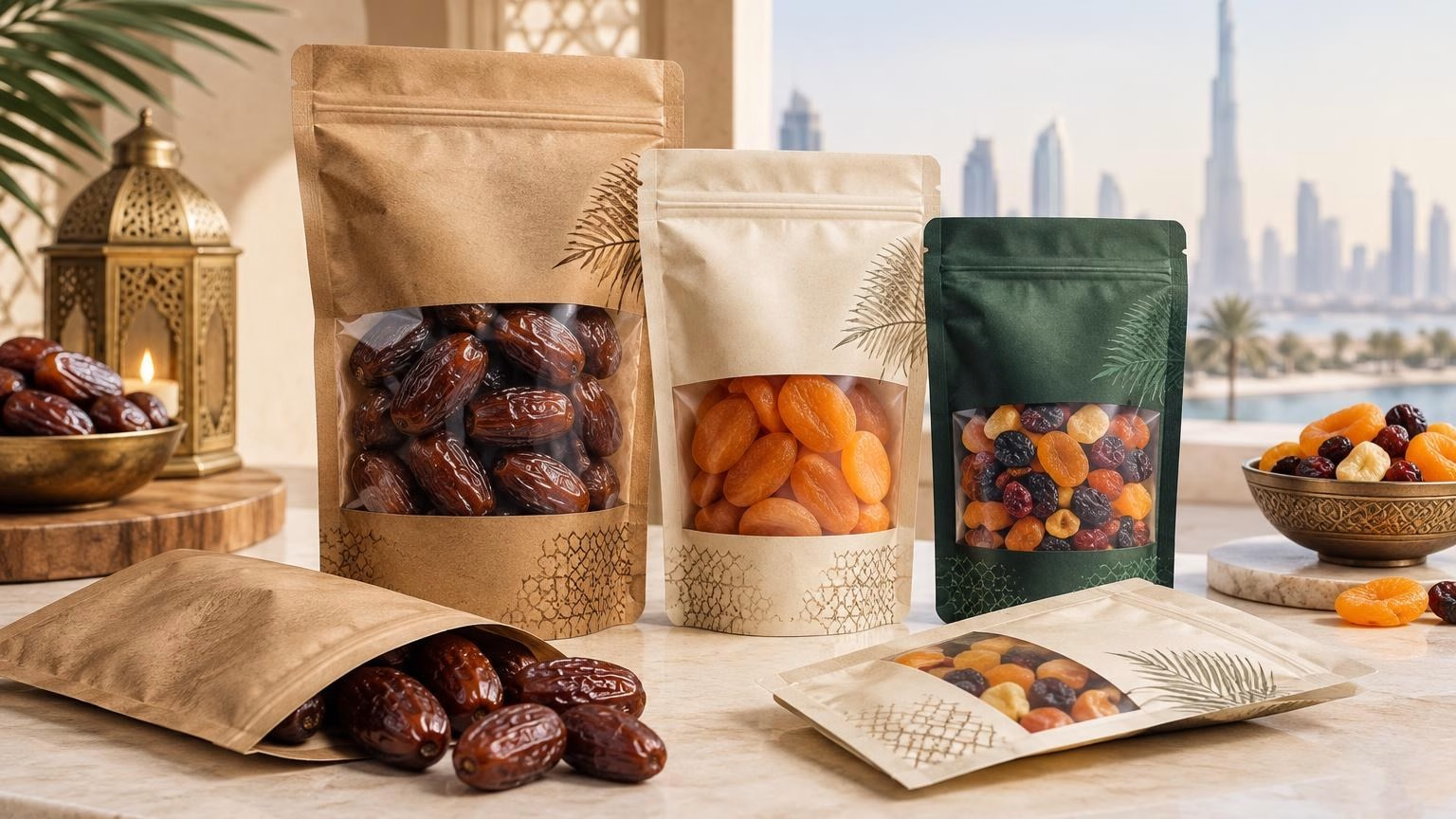
To choose printed date pouches in the UAE, start with the product and how customers will buy, store and use it. Decide whether the pack needs to stand on a retail shelf, what quantity it will hold, what information the customer needs and what storage or distribution conditions it will face. Then confirm that the pouch construction is suitable for the food and agree artwork and order details with your packaging supplier.
Dates and dried fruit are sold in different settings, from gift assortments and retail ranges to everyday snack packs. A suitable pouch should support the product’s handling needs while giving the brand a clear, readable presentation. The right choice is not simply the one with the largest printable area; it is the one that fits the product, sales channel and brand.
Key takeaways
- Choose the pouch format around product quantity, display and customer use.
- Ask the supplier to confirm food suitability and any required packaging protection; do not infer these from appearance alone.
- Plan branding and product information together, then review a proof carefully.
- Estimate quantities by product and sales plan, and confirm order requirements directly with the supplier.
1. Start with the product and selling situation
The product, pack size and point of sale should guide the pouch decision. A pouch for a premium gift assortment may need to present differently from a single-serve snack or a larger household pack. Think about the full journey: filling, storage, transport, retail display and the customer opening or using the pack.
Before discussing formats, write down the basics for each item:
- Product type, such as whole dates, chopped dates, raisins or a mixed dried-fruit selection.
- Planned net quantity and the number of product variants.
- Where it will be sold, such as a shop shelf, an online order or a seasonal hamper.
- How it will be stored and transported, including any exposure to heat, humidity or handling during distribution.
- Whether the pack needs to support repeated opening or another specific customer-use requirement.
These details give a packaging supplier a useful starting point. A format that looks appealing empty may not suit the filled product or the way it will be displayed, so assess the actual use case before approving a design.
2. Compare flat and stand-up pouch formats
Flat pouches and stand-up pouches serve different display and storage needs. A stand-up format may be a sensible option when upright presentation is important. A flat format may suit a simpler presentation or a product that will be displayed in another way. The choice depends on the filled pack, the shelf plan and the brand’s visual priorities.
| Buyer consideration |
Flat pouch |
Stand-up pouch |
| Display |
Consider how it will be positioned or supported at the point of sale. |
Consider whether upright shelf presentation helps customers see the product range. |
| Storage |
Assess how empty and filled packs will be stored and handled. |
Check the space needed for the filled pouch and how it fits the display plan. |
| Branding |
Plan a clear front-facing design that suits the intended display. |
Plan the main design area around the pouch shape and how it will face the customer. |
| Best next step |
Review a filled sample or supplier guidance for the intended product. |
Check that the filled pack presents as intended and suits shelf dimensions. |
This comparison is a starting point, not a specification. Ask the supplier which formats are available for your project and confirm the dimensions and construction before preparing final artwork. For a fuller overview of the display and storage trade-offs, see Flat Pouches vs Stand-Up Pouches: Choosing Printed Packaging for UAE Products.
3. Confirm material and food suitability
Have the proposed pouch material and construction checked for the specific food and intended use. Appearance alone does not confirm whether packaging is suitable for contact with dates or dried fruit, or whether it provides the protection a product needs.
Tell the supplier what the pouch will contain and how it will be stored, transported and sold. Ask them to explain the available material choices and confirm any relevant suitability or performance information for your use case. If the product has particular shelf-life or storage requirements, involve the people responsible for product quality and packaging decisions. Avoid making assumptions about barrier properties or storage life based only on a material name or finish.
UAE distribution can involve different storage and delivery environments. Consider where stock will be kept and how it will move through your supply chain, then discuss those conditions with the supplier. The packaging decision should be based on the product and the conditions it will actually face, not a general claim about what a pouch can do.
4. Make the design work for shoppers
A pouch design should identify the product quickly and make the brand easy to recognise. Give the front panel a clear visual hierarchy: brand, product name and the most useful customer-facing information should not compete for attention.
For a range of dates or dried fruit, use consistent brand elements across the family while making each variant easy to tell apart. This can help customers distinguish products without making every pack look unrelated. Consider whether product photography, illustrations, colour coding or a simple typographic design best reflects your positioning and fits the available print area.
Check all pack copy with the appropriate people in your business before artwork approval. Product descriptions, ingredient details, net quantity and other required information should be accurate and appropriate to the product and market. Do not treat a visual mock-up as approval of regulatory content; confirm applicable requirements with your regulatory adviser or the relevant authority.
5. Prepare artwork and approve a proof
Use the supplier’s artwork guidance before creating the final pouch file. Ask for the current dimensions, dieline, file requirements and any guidance on safe areas or design limitations. Do not guess the printable area from a photograph or a similar pack.
Before approving the final proof, review:
- Product name, variant, spelling and any customer-facing copy.
- Logo size, colour consistency and readability at the actual pack size.
- Placement of important content within the supplied design area.
- Whether the design remains clear when the pouch is filled and displayed.
- Consistency between the proof, approved artwork and the intended product.
Ask how colour and print appearance are reviewed for the specific job, and make sure the proofing process is clear before approval. Any change after sign-off may affect the final design, so settle product details and artwork before confirming the order.
6. Plan quantities and ordering around your range
Plan pouch quantities by product variant, sales channel and expected demand. A single total across a range can hide the fact that one flavour or pack size may sell faster than another. Estimate quantities for each version and consider seasonal sales, launch plans and the space available for storing packaging.
When requesting a quotation or discussing a project, share the product type, intended pouch format, dimensions or target fill quantity, number of artwork versions, and any known storage or distribution requirements. Ask the supplier to confirm available order quantities, production details, artwork requirements and approval steps. These can vary by project, so confirm them directly rather than relying on assumptions.
If you are introducing a new product, consider how you will validate the pouch format and presentation before ordering for a larger rollout. Clarify what samples, proofs or other checks may be available for your particular job. Keep final approved artwork and product information organised by variant to reduce avoidable mix-ups when the range changes.
How to choose printed date pouches: a practical checklist
- Define the use: Note the product, pack quantity, sales channel and customer handling needs.
- Select a format to assess: Compare flat and stand-up options against display, storage and filled-pack requirements.
- Discuss suitability: Ask the supplier to confirm that the proposed construction is appropriate for the food and intended conditions.
- Plan the design: Set a clear brand hierarchy and prepare accurate details for each product variant.
- Review the proof: Check the supplied design area, readability, product details and final presentation.
- Confirm the order: Agree quantities, artwork versions, project requirements and approval steps with the supplier.
Frequently asked questions
Which pouch format should I consider for dates?
Consider how customers will encounter and use the product. A stand-up pouch can present a pack upright on a shelf, while a flat pouch may suit a simpler format or a pack that does not need to stand. Compare the filled pouch, product quantity, storage and display needs before choosing.
What should I check before selecting pouch material for dried fruit?
Ask the packaging supplier to confirm that the proposed material and construction are suitable for the specific food and intended use. Discuss the product, expected storage and distribution conditions, and any protection requirements. Do not assume that a material is food-suitable or offers a particular barrier without confirmation.
Can I use the same pouch design for dates and other dried fruit?
A shared design may work for a product range, but each item may need different product details, pack sizes or handling information. Check that the packaging format suits each product and that the final artwork clearly identifies the contents. Confirm any required information with your packaging and regulatory advisers.
What artwork should I prepare for printed date pouches?
Prepare your logo, brand colours, product name and the information intended for the pack. Request the printer’s artwork specifications and dieline before finalising the design. Check dimensions, safe areas, legibility, spelling and all product details on a proof before approving production.
How should a UAE brand plan pouch quantities?
Estimate demand by product, pack size and sales channel, then account for seasonal campaigns, retail display and storage capacity. Ask the supplier about available order quantities and production requirements rather than assuming a minimum. If a design is new, clarify what proofing or approval steps are available before committing.
Discuss your pouch requirements
Choosing packaging is easier when the product, intended use and artwork are clear. Contact IWPrinting to discuss your printed pouch requirements for dates or dried fruit in the UAE, and confirm the available options and project details before proceeding.
Related IWPrinting products and guides